The Six Phases of Production Every Stage Manager Should Know
Bryan Runion ·
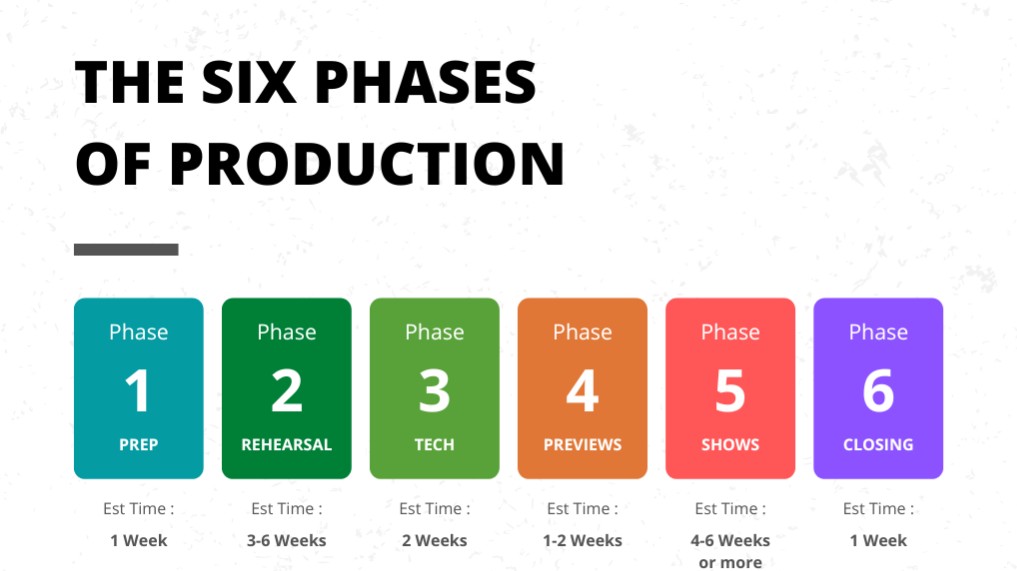
Stage managers live through the six phases of production. Here’s how each phase shapes leadership and why the invisible work matters most.
Most people only see a finished performance. Stage Managers live inside the unseen process that makes it possible — moving through each phase, translating vision into reality, and holding the production steady when the room tilts.
Every show has its own rhythm, but most fall into the six phases of production: pre-production, rehearsal, tech, previews, shows, and closing. Each stage asks something different of a stage manager, and how we show up in these moments often defines the leadership we practice.
Phase One: Pre-Production
Pre-production is the first stage in the six phases of production. It’s when Stage Managers create the scaffolding that will hold the process: paperwork, rehearsal room setup, communication channels, calendars, and team norms.
Pre-production is less about control and more about clarity. A strong file-sharing system — whether Google Drive, Dropbox, or another tool — isn’t just storage, it’s a signal that transparency matters.
First conversations with directors set tone. Asking about break preferences, daily rhythms, and staging concerns gives insight into how they lead — and what they expect from you.
Building team trust early pays off later. Stage management is collective work, not a solo act, and autonomy only thrives when information flows freely.
Pre-production isn’t glamorous. But it’s moral work — the preparation that makes resilience possible when chaos hits.
Phase Two: Rehearsal
The rehearsal phase is the longest and most elastic of the six phases of production, and understanding its dynamics is essential. I’ve written more in-depth about what stage managers should know about the rehearsal process
The first rehearsal carries weight. It’s not just a table read, it’s the moment when a group becomes a company. Setting a tone of openness and steadiness matters.
Daily rehearsal reports are more than administrative updates — they’re the connective tissue keeping designers, directors, and managers aligned.
Rehearsals are also about tracking. Not just blocking, but the invisible flow of energy: when an actor struggles, when a scene shift drags, when the team needs more time at the table before moving onstage.
Rehearsal is where leadership shows its quiet power. Presence matters more than polish, and questions often carry more weight than answers.
Phase Three: Tech
Tech rehearsals are a crucible, and for many Stage Managers, the most intense of the six phases of production. They bring the artistic and technical worlds together, often under pressure, with stage management at the center of that collision. The tech phase is all about weaving staging with lighting, sound, costumes, and scenery into one coherent story. Resources like USITT’s stage management tools highlight how industry standards can support this phase and give stage managers additional frameworks for managing complexity.
Communication shifts. Assistant Stage Managers become your eyes and ears, relaying stage-level realities while you manage the larger arc. Trust here is essential.
The pace is deliberate. Tech isn’t about rushing to the end — it’s about weaving light, sound, costumes, and scenery into the story with care.
The “voice of god” mic, headset chatter, and cue sequences aren’t just tools. They’re how a room stays sane when forty people are waiting for the next move.
Tech tests a Stage Manager’s ability to hold space for detail without losing sight of the whole. It’s where logistical expertise becomes artistry.
Phase Four: Previews
Previews are perhaps the most unpredictable of the six phases of production. They combine rehearsal, tech, and live performance into one compressed cycle.
Previews invite iteration. Directors tweak pacing, cut lines, reorder scenes, and rework transitions based on audience response. Flexibility is survival.
Tracking every change matters. A clear record ensures reversibility when ideas don’t land. It’s like version control for live art.
Boundaries help. With limited hours before an evening show, knowing what’s realistic to tackle protects both the process and the people.
Previews demand presence and communication. When the room feels frayed, a steady stage manager voice — transparent, respectful, repeatable — can restore balance.
Phase Five: Performances
Performance is the most visible of the six phases of production, but for Stage Managers it’s the shift from building to maintaining.
Opening night is handoff night. Designers step back, and the stage management team takes ownership of consistency.
Audience response becomes part of the show. Each night is different, and part of the stage manager’s work is holding space for those differences without destabilizing the run.
Long runs require stamina. A three-week residency feels different than a multi-year commercial production. Both test leadership in different ways — one through intensity, the other through endurance.
Performance is where leadership becomes rhythm — and sometimes the smallest details matter most. This connects closely to the micromanagement myth, a reminder that detail-oriented leadership can be a strength, not a flaw.
Phase Six: Closing
Closing is often overlooked, but it is the final stage in the six phases of production.
Documentation ensures the production’s afterlife. Prompt books, reports, and files aren’t just archives, they’re guides for future teams.
Emotional closure matters. Celebrating the company, acknowledging the work, and marking the end is as important as opening.
Clean systems ease the transition. A production may only exist once, or it may return years later. Either way, your clarity in closing becomes someone else’s lifeline.
Closing is both an ending and a handoff. It’s a reminder that our leadership isn’t about permanence, but stewardship.
Key Takeaways
The six phases of production — from pre-production to closing — define the rhythm of every show.
Each phase requires a different kind of leadership, from preparation to presence to endurance.
Stage managers thrive in the invisible work: communication, tracking, documentation, and care.
Stage management is often described as the “center of the wheel.” The six phases of production are the spokes — distinct but interdependent, holding the work in motion.
📌 Want to keep growing in your leadership practice? Subscribe to Half-Hour for real stories, practical strategies, and reflections that help you lead with clarity